| |
- How will a new schedule, or a new fleet structure, influence my crew costs?
- Will a new fleet influence the preferred crew base structure?
- Will minor agreement changes be sufficient to improve the utilization of the new fleet?
A change of just one per cent in crew productivity
represents seven figure savings or costs for a midsized airline’s operations.
With extensive experience and unique tools Carmen can advise on how to
change rules and how to rapidly make expert evaluations and simulate operational
modifications. This enables you to make decisions based on facts.
To give you an idea of how a new schedule or fleet
structure will influence the crew operation, Carmen can perform a comparative
study between the existing schedule and the new schedule.
The most important result is the relative difference
between today’s crew cost and the crew cost with the new schedule.
In the study, we plan anonymous crew using various
scenarios and in different time periods. All change scenarios are compared
to a base line using your existing regulations only. This ensures that
the final comparisons will be independent of the planning tools used today.
We use Carmen Crew Pairing, the same tool used
by many of the world’s leading transportation companies for the technical
aspect of the study.
We start the project with agreeing on the scope
and the goals. You explain your questions and we bring up potential problems
based on our experiences from the airline industry. Following this we
set up the system and maintain close contact with your staff to perform
the analysis. We plan for cockpit and/or cabin crew, using weekly schedules
over three time periods for up to four different timetables. If more appropriate,
daily or monthly planning can also be carried out.
The basic analysis can be expanded to cover even
more. It is possible to investigate any number of regulation changes or
even entirely different agreement structures, alternative quality criteria
and cost structures, timetable revisions, etc. It is also possible to
focus on capital expenditure, new fleet transition costs, revenue fluctuations
due to new fleet or network structures, maintenance related costs, etc.
|

|
If you have any questions about the Fleet and Schedule Analysis, please contact us at [email protected]
|
|
| |
- Advice on potential improvements
- Cost comparisons for all scenarios
- Detailed planning scenarios
- Analysis of each scenario
|
|
| |
| |
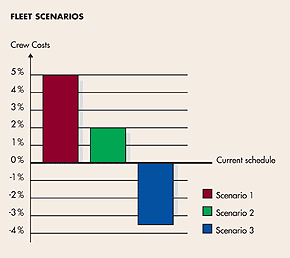
Diagram showing the difference between today’s crew cost and three new fleet scenarios. |
To get Acrobat Reader click here:

|
| |
| |
| |
- Report on cost difference between crew base scenarios
- Normally within 1 month from receipt of data
- An extended scope may affect the delivery schedule
|
|
|
- Timetables (one or two) and required time periods (1)
- Today’s crew data (required distribution of crew per duty base, in duty days or block hours)
- Aircraft rotations for each timetable (2)
- Industrial regulations
- Crew agreements
- Cost structure (major cost drivers such as daily crew costs, credit time, etc) (2)
- Major stability criteria (minimum crew connection times, standard delay buffers, etc) (2)
(1) Can also be extracted from standard OAG.
(2) Can be simulated, if information is unavailable.
|
|
|
| |
| |
|









